
After all, what is Agile HR?

If we look at Google searches for the term Agile HR, we see that they nearly tripled between 2016 and 2019. Every day, more professionals look for information and training about agility. But what exactly is Agile HR, and what changes in a company’s People function when it adopts agile values in its practices? We’ll give an overview in this article, and I invite you to explore the subject further with our ebook, the Practical Guide to Agile HR.
The foundation and inspiration for Agile HR comes from the Agile Manifesto for Software Development, written by a group of professionals in 2001 as a statement of the best practices for software development. Applying agile values and principles brought many benefits to the teams that adopted them and to their companies, and it also changed the role of leaders for the better. These benefits include:
-
Greater adaptability to the inevitable changes that arise as projects are carried out;
-
Fewer errors, since teams test on a small scale before expanding;
-
Constant interaction with the customer, which enables more feedback and better adjustments to the software to meet their needs;
-
Greater agility in delivering value to the customer, who can follow the progress of the project;
-
Higher quality in the final product, since valuable deliverables are produced throughout the cycle;
-
Greater customer satisfaction;
-
More autonomous teams, which positively affects each member’s engagement and sense of belonging;
-
Facilitative leaders who are more open to dialogue and diversity, instead of authoritarian leaders.
These benefits, among many others, led agile values to spread to other areas, such as Marketing, Education and Human Resources.
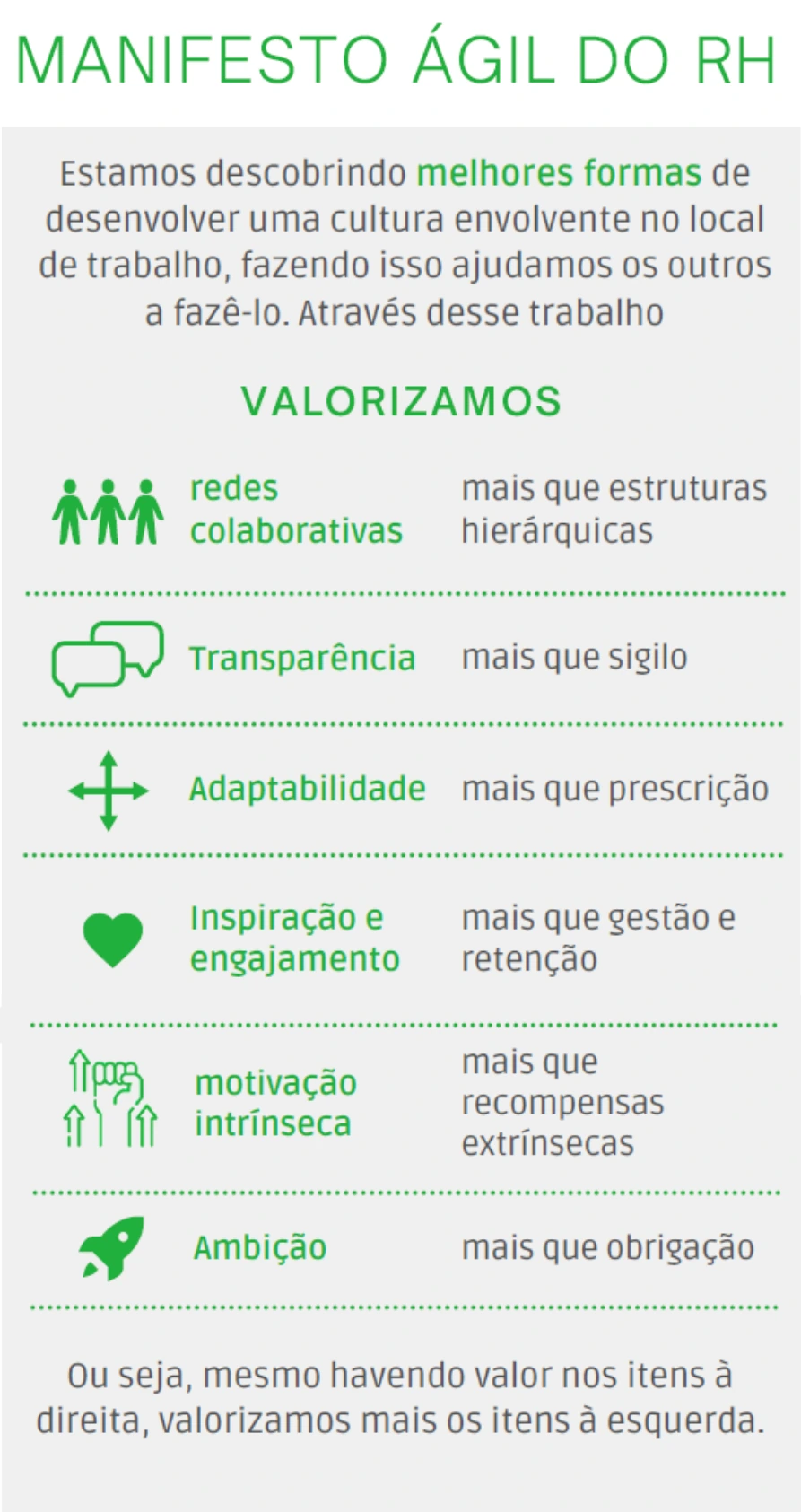
Inspired by these values, in 2018 a group of People professionals from different companies came together to create the Agile HR Manifesto, with six values and five principles. It serves as a compass for HR professionals who want to navigate these waters and enjoy the many benefits of these practices.
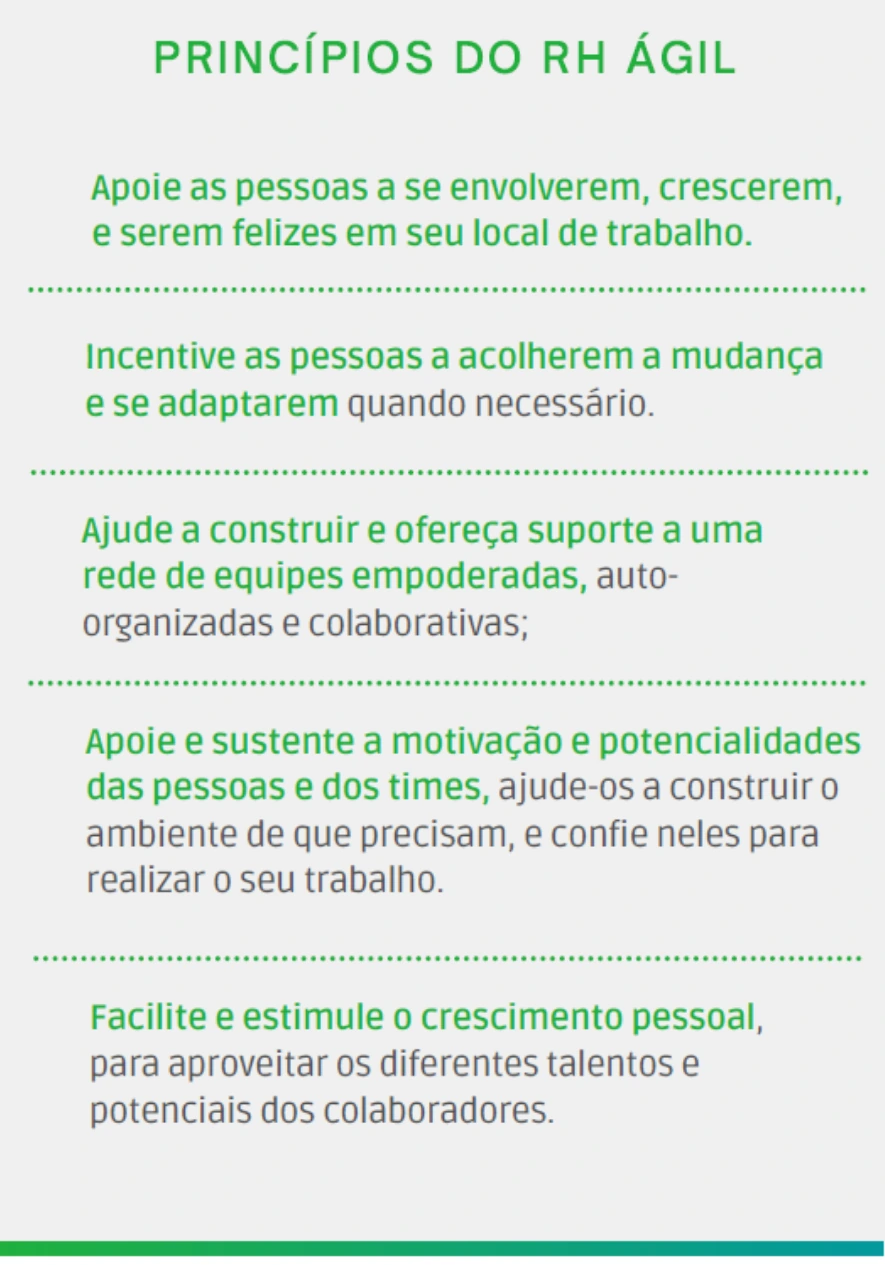
Traditional HR and Agile HR differ in fundamental ways. The most important is the shift from the first one’s mechanistic approach to the second one’s organic approach. In Agile HR, we see a company not as a machine in which each part performs one function and only that function, but as a living, complex and nonlinear organism. This means that people throughout the company become HR agents. HR moves away from control and takes on the role of a facilitator.
In practice, this means that functions traditionally considered “HR’s job” are distributed throughout the organization. Teams handle their own hiring and dismissal decisions. Learning and Development is understood much more broadly and is not limited to specific events: people are constantly sharing knowledge and developing. Leaders no longer dictate how tasks should be done; they clarify what needs to be done and let people find the best way to do it.
Guided by agile values, we value collaborative networks over hierarchical structures. Collaboration among people in the same department, between departments and across company locations enables a rich exchange of knowledge. This helps the company share best practices and improve its processes.
Collaboration also requires space for dialogue and openness to diversity, including different points of view. This can lead to conflict, which is not a problem as long as the conflict is healthy. An innovative company will inevitably experience this kind of conflict.

We value transparency over secrecy. In Agile HR, the People function is no longer the keeper of confidential information and organizational secrets. Instead, it works with leaders and teams to build communication that is fluid, transparent and clear. The autonomy so valued in agile settings cannot be built without transparency and access to important information. Teams can make good decisions autonomously only when they have all the information they need.
We value adaptability over prescription. A company cannot be agile without flexible processes. Rules matter in some contexts, such as safety and food-product quality, but few people love creating rules as much as HR professionals do. Policies, standards and rules for everything — and so it goes. The bigger issue is that these rules are not always agreed on with people, discussed or co-created. Sometimes HR creates rules based on what it believes is best for others without checking whether that is actually the best option. Co-creation is one of the most fundamental principles of Agile HR. We do not create for people, assuming that we know what is best. We create with them, checking whether we actually met our customers’ needs.
We value inspiration and engagement over management and retention. If we look up the word retain in a dictionary, we find meanings such as keep in one’s possession, detain, hold back and imprison. So when we talk about retaining employees, we are really taking away their freedom and imprisoning them. Harsh, isn’t it? You might say, “But turnover is a problem for the company: knowledge is lost, the team and the company suffer, and the customer loses out too.” I completely agree. The point is that Agile HR does not want to imprison people. It wants to give them great reasons to feel inspired and want to stay with us.
We value intrinsic motivation over extrinsic rewards. We cannot motivate people; motivation comes from within each person. But we can help people in our company understand what motivates them and bring those motives into our People practices and processes. It is important to remember that each person has different motivators. What motivates one person may even demotivate another.
We value ambition over obligation. In Agile HR, it is important to understand what each person enjoys doing and what helps them enter a state of flow. Someone doing work they enjoy will certainly produce better results than someone doing it only out of obligation or because it is part of their job title. Focusing on roles rather than positions can help with this.
All these values make up Agile HR and help us achieve benefits such as:
-
Higher-value outcomes for employees and the business;
-
Greater ability to adapt to the situations the company faces at any given time;
-
Greater autonomy for employees;
-
A better fit for each employee’s individual needs and each department’s particular circumstances;
-
A more human-centered HR function, with people at the center and a positive effect on their engagement, sense of belonging and motivation.
To learn more and get tips on recruitment and selection in Agile HR, performance reviews, feedback and compensation in this context, and learning and development processes, download our Practical Guide to Agile HR. It offers useful insights into applying agile values in the People function at your company. We would also love to hear your feedback on the ebook ;)